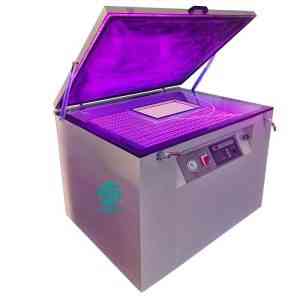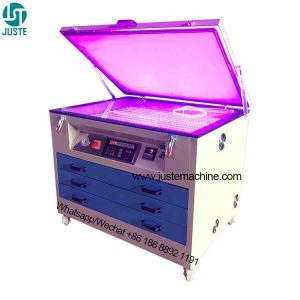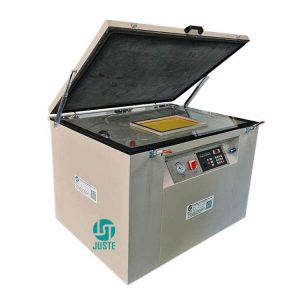
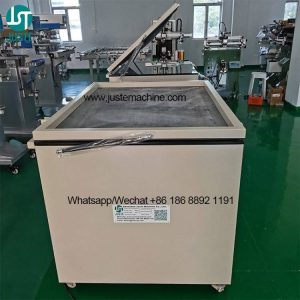
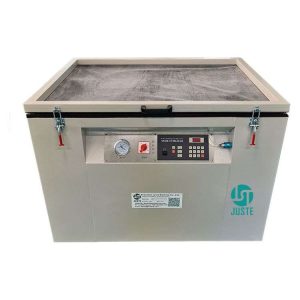
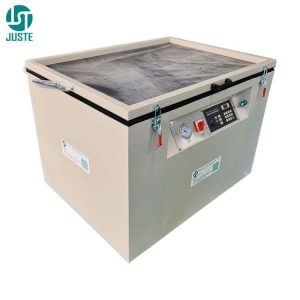
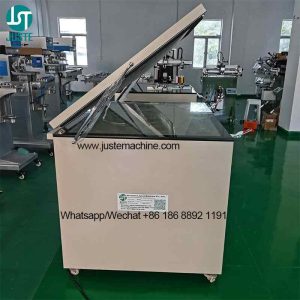
UV Mercury Lamp Exposure Machine
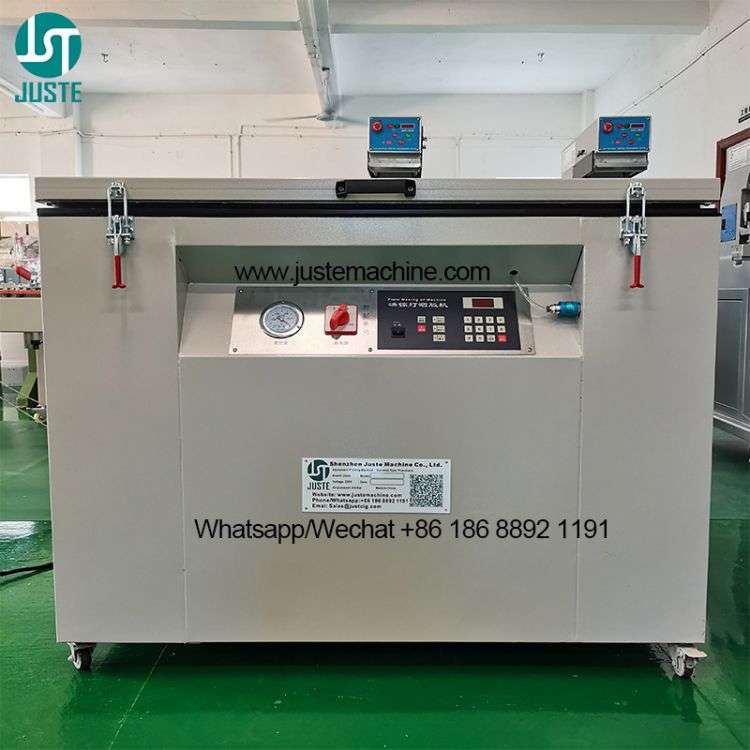
The JST-EX90120T utilizes traditional mercury uv lamp exposure machine technology with
cost-effective mercury lamp illumination. This robust exposure machine vacuum pump system delivers
high-intensity UV output and broad spectrum coverage suitable for various emulsion types. The proven
technology provides reliable performance for shops requiring dependable flexo plate exposure machine
capabilities with minimal operational complexity.
Products Description
| Brand | JUSTE |
| Model | JST-EX90120T |
| Machine dimension | 1200×900×900mm |
| Max exposure size | 700*900mm |
| Exposure Time | 35-55 Second |
| Machine weight | 150KG |
| Voltage | 220V/50HZ |
| Light Source | Mercury Lamp 365nm |
| Power | 2KW |
| Evenness of Exposure | Above 90% |
| Line wide&space | 3-4μm |
| Vacuum speed | 0-140kpa |
| Light source wave length | 350-450nm range |
| Exposure time tolerance | Less than 0.5s |
| Working noise | Less than 70dB |
| Light tube cooling | Fan cooling cabinet system |
| Motor | TECO Electric of TW |
| Vacuum pump | Oil-free double circuit pump of TW |
Procedure Overview:
Phase 1: Screen Coating
Perform this step in a darkroom or under suitable yellow safety lighting to prevent premature exposure.
Apply a uniform layer of photosensitive emulsion to the entire surface of the screen mesh.
Employ a scoop coater to deposit and smoothly spread the emulsion, creating a consistent blue film.
Allow the coated screen to rest undisturbed for a few minutes until the emulsion is touch-dry.
The plate is now sensitized, analogous to a prepared surface waiting for an image to be inscribed.
Phase 2: Film and Screen Registration
Lay the film positive (emulsion side up, typically) centrally onto the clean glass surface of the exposure unit.
Carefully lower the prepared screen plate onto the film, ensuring the coated (blue) side faces down and
makes direct contact.
A critical requirement is perfect, gap-free contact between the film’s imagery and the screen’s sensitized layer
Any separation will cause a loss of definition.
Phase 3: Vacuum Application
Close the exposure unit’s flexible cover, typically made of rubber or a similar material.
Activate the vacuum system. This will evacuate the air, creating a powerful suction that presses the screen
and film firmly against the glass.
This action ensures intimate contact across the entire surface, eliminating air pockets that could allow
UV light to scatter and blur the final image.
Phase 4: UV Light Exposure
Start the exposure timer. This triggers the UV light source to activate.
Powerful ultraviolet rays penetrate the glass and the clear portions of the film, striking the photosensitive
emulsion directly beneath.
In these exposed areas, the emulsion undergoes a chemical reaction, becoming hardened and insoluble.
Where the film is black and opaque, the UV light is blocked, leaving the underlying emulsion soft and unhardened.
The required exposure time is determined by factors like emulsion type and light intensity and is typically brief.
Phase 5: Image Development
After exposure, release the vacuum and open the unit. The screen will not yet show a visible change.
Remove the film positive. Subsequently, take the screen to a washing area and gently spray or rinse the
emulsion side with water.
The developing action reveals the image:
The unexposed, soft emulsion (under the film’s black areas) washes away completely, leaving open,
permeable mesh that will define the printed image.
The hardened emulsion in the exposed areas remains firmly bonded to the mesh, blocking ink passage
and forming the stencil’s solid areas.
Once fully washed, the screen clearly displays the positive or negative of the original film design.
Phase 6: Final Drying and Curing
The developed stencil is now water-saturated and delicate. Transfer it to a drying cabinet.
Circulating warm air within the cabinet rapidly and thoroughly dries the screen.
Drying solidifies the stencil. For maximum durability, many practitioners perform a post-exposure or
final hardening step: the completely dry screen is re-exposed to UV light (without vacuum) for a short period.
This fully cross-links and toughens the emulsion.
The screen printing stencil is now complete, cured, and ready for the printing press.
Concept Summary:
This process is a photographic stencil-making technique. It relies on the differential hardening of a
photosensitive layer by UV light, controlled by a film negative or positive. Vacuum pressure ensures critical
contact fidelity, resulting in a high-fidelity stencil where the design is rendered as open mesh within a solid,
impermeable background.
Cost-effective mercury lamp technology with proven reliability
High-intensity UV output for faster exposure times
Broad spectrum compatibility with various emulsion types
Industrial-grade construction for continuous operation
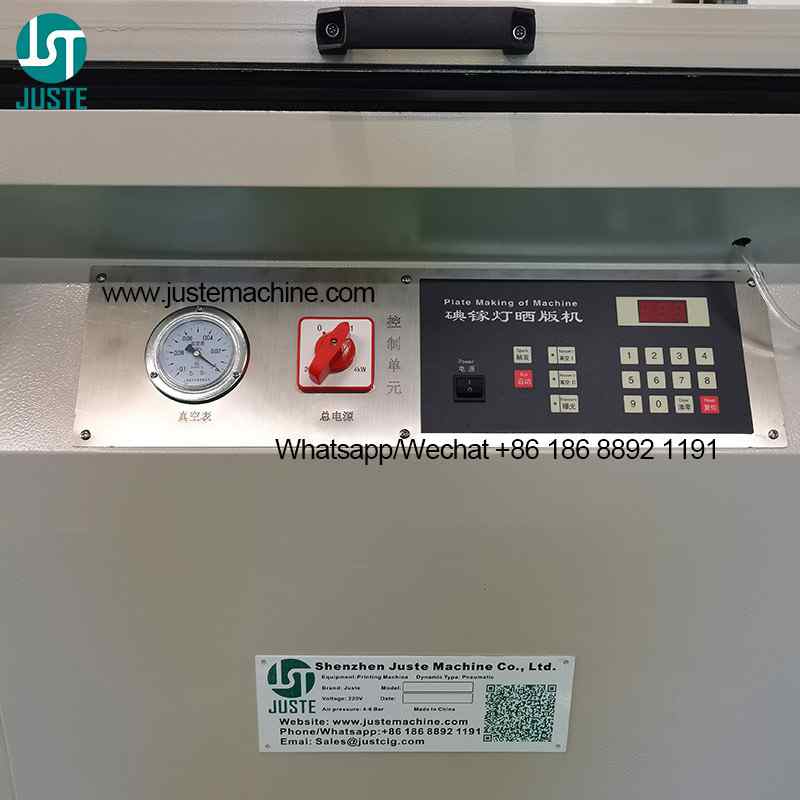
Control Panel for screen printing exposure machine
Control interface for screen exposure machine featuring adjustable timer and vacuum controls for precise
exposure management.
Simple timer adjustment for different emulsion types
Straightforward operation with minimal training required
Reliable mechanical controls for daily use
Clear indicators for operational status

Vacuum System for exposure machine vacuum pump
Vacuum system for serigrafi exposure machine providing strong suction for perfect film-to-screen contact.
Rapid air evacuation capability
Consistent vacuum pressure maintenance
Durable industrial pump construction
Essential for high-definition stencils
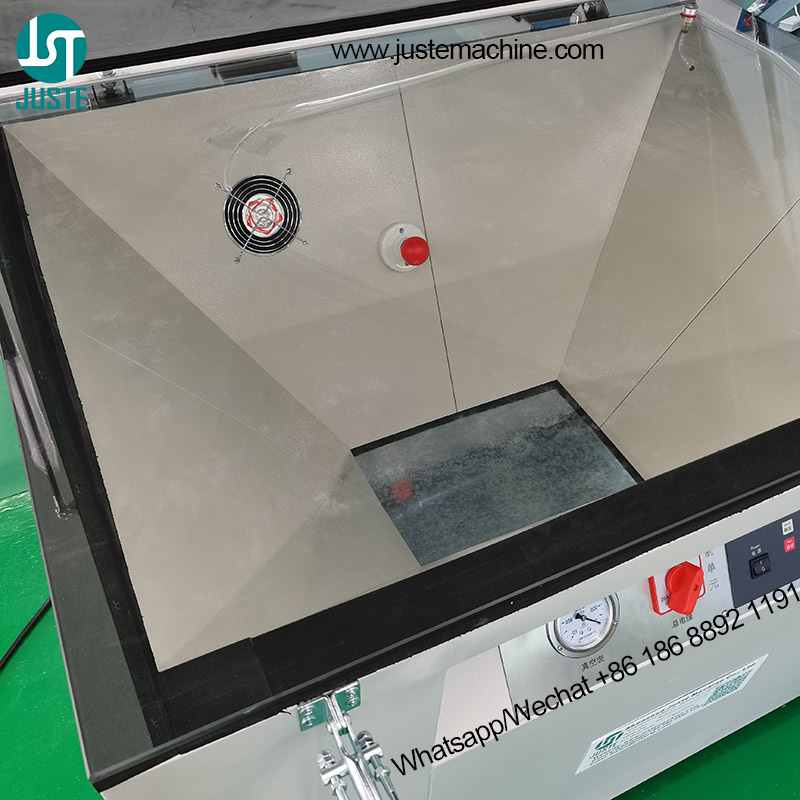
Mercury Lamp for uv lamp exposure machine
Mercury lamp for serigrafia exposure machine delivering high-intensity broad-spectrum UV illumination.
Cost-effective lamp replacement
Broad spectrum UV output
High-intensity exposure capability
Proven technology reliability
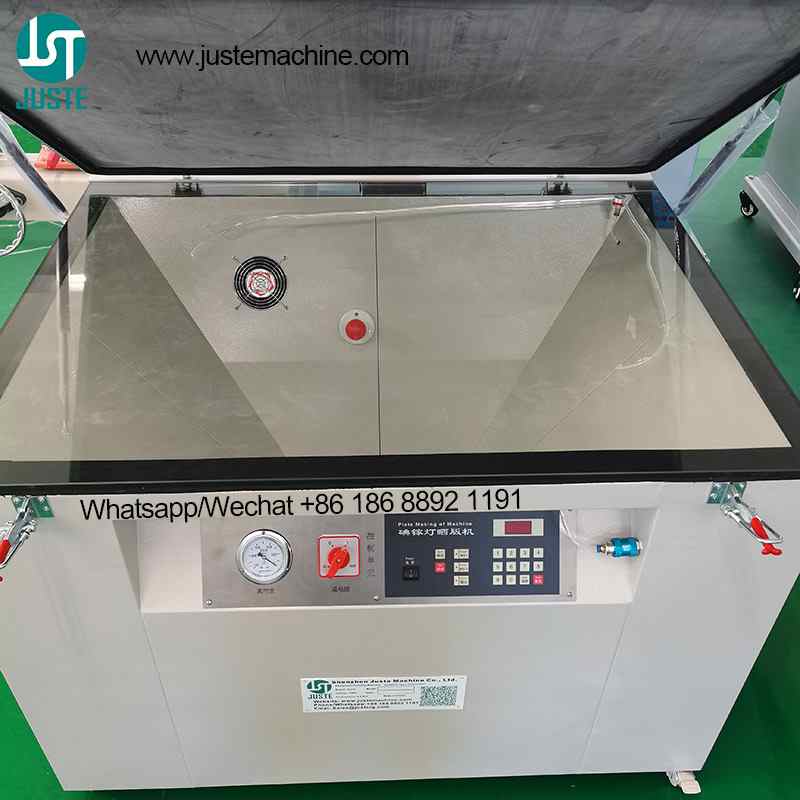
Sealing Clamps for vacuum uv exposure unit screen printing machine
Sealing clamps for screen printing exposure machine ensuring complete vacuum integrity during exposure.
Heavy-duty clamping mechanism
Even pressure distribution
Reliable vacuum maintenance
Durable daily operation design
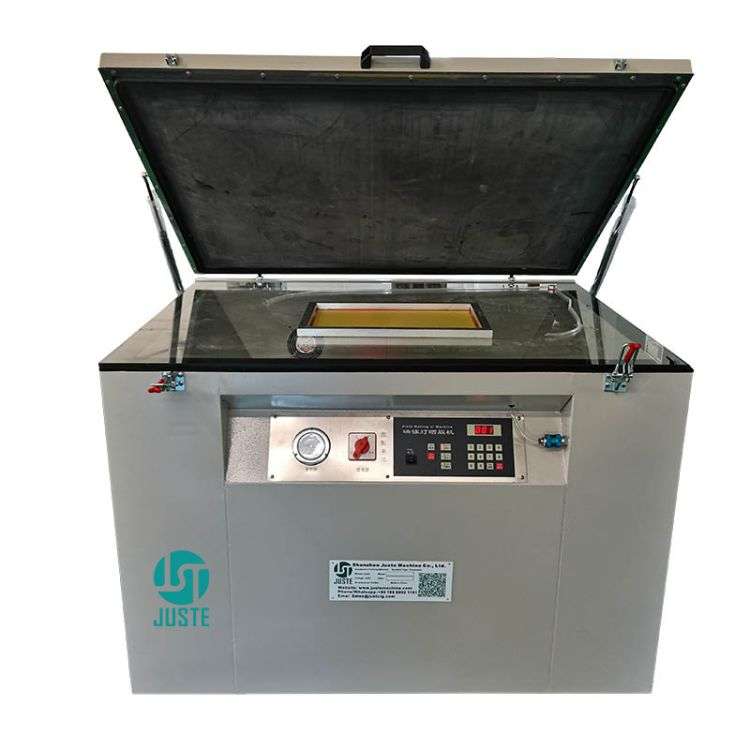
Exposure Chamber for uv exposure machine for silk screen
Active exposure process demonstration showing mercury lamp illumination through film artwork.
Full-spectrum UV coverage
Even illumination across entire area
Rapid exposure capability
Consistent performance output
Juste Print Machines Application Area
Medical equipment, Energy equipment, Semiconductor industry. Such as Products for glassess,
lense, pen, PVC ball, mug, toy, doll eye, sun glass, gift item, T-shirt, baby cloth, bra, eyeglass, toys,
umbrella, underwear, fruit apple, shoe, insole, watch dial number, garment, face mask, plastic cap,
safety helmet, hard safe hat, metal lens industry fabric etc.
Juste Prints Machines Application Area
Food and beverage, Toys, Mask Protective Equipment, Tableware, Beauty Makeup products,
Sports equipment, Lights & lighting, Electronic products, Washing and Cleaning products,
Household appliances, Textiles and clothing, Communication equipment, Auto Motorcycle parts.
Machines Packaging
Print Machine With tri-ply wooden case packing, the wood pallet material as fumigation wooden.
It is strong fix wooden case for sea shipment.
Printing Machines will be well packed in tri-ply wooden box then load to container and shipped
by sea/by air, as your requested.
Shipping Term
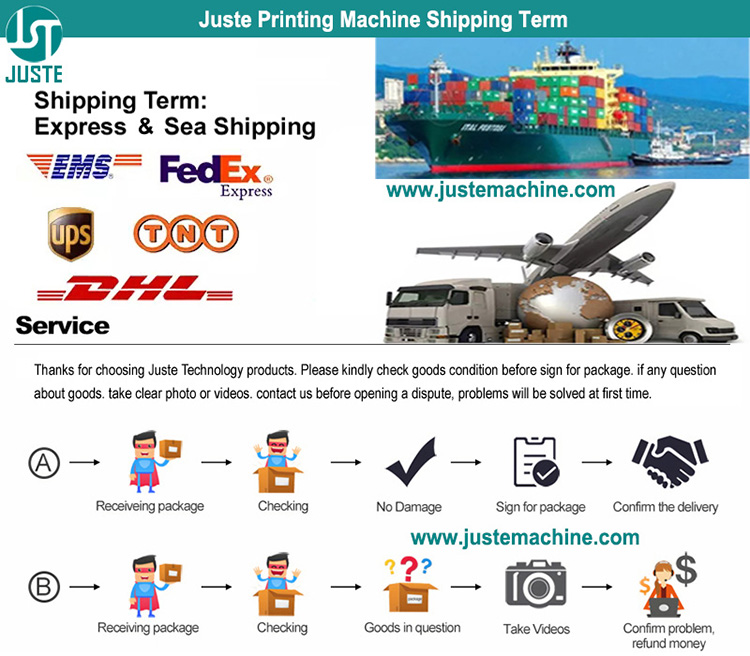
Shipping Time
Sample delivery time: 5-15 days by DHL/UPS/TNT/FEDEX express, Sea shipping
Bulk Order Shipping time: 5-15 Workdays by Express / 15-30 days by sea..
Company Information
About Shenzhen Juste Machine Co., Ltd.
Established in 2002, Shenzhen Juste Machine Co., Ltd. has built a reputation as a reliable Pre-press
equipment manufacturer with specialized expertise in exposure technology. Our comprehensive
manufacturing capabilities include producing high-performance uv exposure machine solutions for
diverse printing applications.
As an experienced exposure machine factory, we balance traditional engineering excellence with
practical manufacturing expertise. The JST-EX90120T screen printing exposure machine exemplifies
our commitment to providing robust, cost-effective solutions for printing facilities requiring reliable
mercury lamp technology.
We serve multiple industries including commercial printing, packaging, and industrial applications,
offering customized solutions and comprehensive technical support to ensure optimal machine
performance and customer satisfaction.
How To Order
How To Place Mercury Lamp Exposure Machine order?
Initial Discussion: Contact our sales team to review your specific screen making requirements
Needs Assessment: Provide details about your typical screen sizes, production volume, and
emulsion preferences
Detailed Proposal: Receive complete technical specifications and commercial quotation
Order Validation: Review and approve the proforma invoice to initiate production
Manufacturing Phase: Skilled assembly and calibration of your machine
Quality Verification: Comprehensive testing and performance validation
Secure Packaging: Professional preparation for international shipping
Shipping Coordination: Arrangement of reliable transportation from Shenzhen
Delivery Management: Continuous tracking and updates throughout transit
Commissioning Support: Technical guidance for initial setup and operation
FAQ
Q1: What are the advantages of mercury lamp technology?
Mercury lamps in our uv lamp exposure machine provide cost-effective operation, broad UV spectrum
compatibility, and high-intensity output suitable for various emulsion types and production requirements.
Q2: How does the vacuum system ensure quality?
The industrial-grade exposure machine vacuum pump creates perfect film-to-screen contact,
essential for producing sharp, high-definition stencils with crisp edge detail in our vacuum uv exposure
unit screen printing machine.
Q3: What is the maximum screen size capacity?
This screen printing exposure machine accommodates screens up to 1200x900mm, suitable for most
commercial and industrial printing applications requiring consistent, high-quality stencil production.
Q4: What power requirements does this system have?
Operating on standard 220V/50HZ power, this uv exposure machine delivers high-performance exposure
capabilities while maintaining reasonable energy consumption for production environments.
Q5: What technical support is available?
We provide comprehensive operational documentation, maintenance guidelines, and technical support to
ensure optimal performance of your exposure unit machine for screen printing.
Q6: What warranty protection is included?
All machines include 12-month comprehensive warranty coverage, protecting your investment in this
reliable screen exposure machine for professional printing applications.
All machines must be passed by our QA inspection department before shipping.
Contact Us
Phone: +8618688921191
Whatsapp/wechat:+8618688921191
Home View More