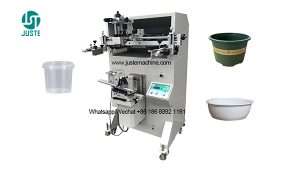
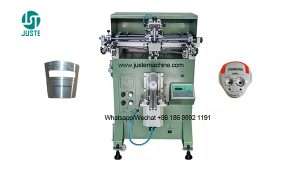
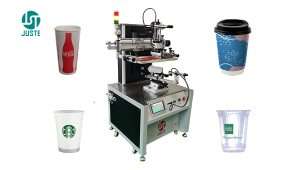
Hochwertige Logos drucken auf Plastikbecher erfordert Präzision, Beständigkeit und die richtige Maschinenkonfiguration. Der JST-R300-ACSM ist ein vollautomatischer Einfarben-Siebdrucker, der speziell für randlosen Plastikbechern — PP und PET — mit einem optionalen Upgrade-Paket, das einen hochpräzisen Mehrfarben-Overprint ermöglicht. Dieser Artikel führt durch den kompletten 8-Stationen-Workflow und deckt jede kritische Phase vom Einzug bis zum Stapeln ab. Ob Sie drucken Tumbler-Bechern, Reisetumblern, Kaltbechern im Starbucks-Stil, Smoothie-Becher, oder Fruchttee-Becher, dieser Leitfaden erklärt, wie jede Komponente funktioniert – von der kundenspezifischen Vorrichtung und dem Corona-Vorbehandler bis zum Leuze-Kontrastsensor (für Mehrfarbenregister) und dem UV-Härtungssystem. Sehen Sie sich an, wie unser Ingenieur Alan die Maschine und ihre optionalen Upgrades erklärt, und buchen Sie dann eine kostenlose Live-Demo mit Ihrem eigenen Produkt bei unserem englischsprachigen Support-Team.
In diesem Artikel erfahren Sie:
✅ Wie der 8‑Stationen‑Drehtisch den gesamten Becherdruckprozess durchgängig automatisiert
✅ Warum randlosen Plastikbechern sind die perfekte Ergänzung für das Zuführungssystem dieser Maschine
✅ Was die optionale Mikroregister-Nachrüstung (Leuze-Sensor + 2 Servomotoren) für den Mehrfarbendruck bewirkt
✅ Praktische Lösungen für Tintenabblättern, Geisterbilder und Bildschirmwartung
Video: Ingenieur Alan erklärt den JST-R300-ACSM — Schlüsselfunktionen & optionale Upgrades
In diesem Video führt Sie unser Ingenieur Alan durch die JST-R300-ACSM, erklärt jede Schlüsselfunktion und hebt die Vorteile des optionalen Upgrade-Pakets hervor. Alan behandelt den 8-Stationen-Drehteller-Workflow, die Rolle der Coronabehandlung für PP/PE-Materialien, den Mechanismus der Druckstation, das integrierte UV-LED-Härtungssystem und den automatischen Stapelprozess. Er gibt auch einen detaillierten Einblick in die Mikroregistrierungs-Upgrade — mit dem deutschen Leuze-Kontrastsensor und zwei zusätzlichen Servomotoren — was hochpräzisen mehrfarbigen Überdruck auf einer einfarbigen Maschine ermöglicht. Alan spricht fließend Englisch und beantwortet technische Fragen in Echtzeit, genau wie in einem privaten Videoanruf mit Ihnen.
Kernfunktionen auf einen Blick
Druck konisch Plastikbecher (PP, PET) — 4–32 oz — mit vollautomatischer Präzision. JST-R300-ACSM is a direct‑from‑manufacturer solution — entworfen, montiert und getestet in unserer 9.000+ m² Anlage in Shenzhen.
Leuze Kontrastsensor + 2 Servomotoren für Mehrfarbenüberdruck
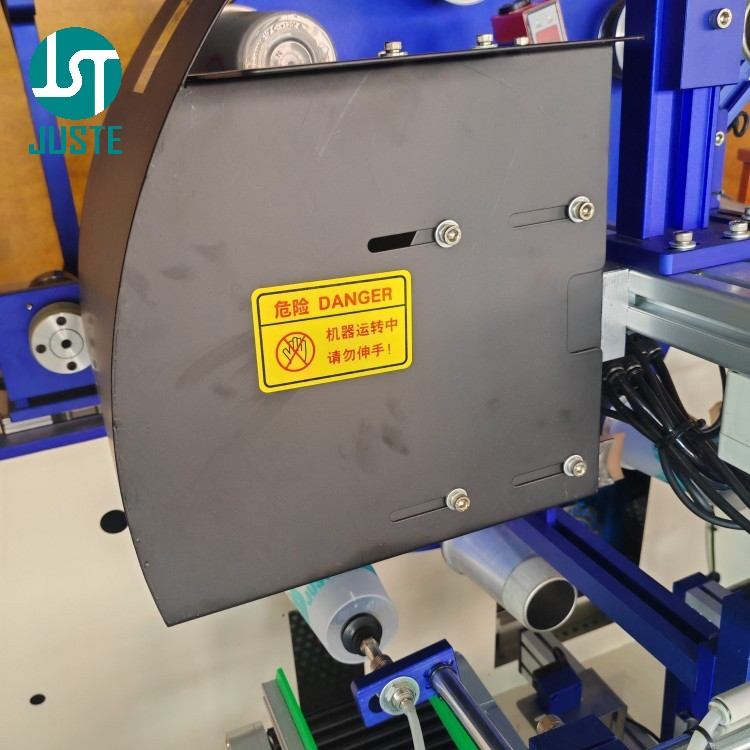
⚠️ Important: Diese Maschine ist speziell konstruiert für tapered/conical plastic cups and bowls. Es ist nicht geeignet für reine zylindrische Behälter.
Kompletter 8-Stationen-Workflow: Bedrucken eines randlosen Plastikbechers
📌 Note: Dieser Abschnitt folgt einem strukturierten How‑To‑Format, was ihn ideal für HowTo Schema Markup. Jeder Schritt ist eine sequenzielle Aktion, die Benutzer befolgen können, um den gesamten Druckvorgang auf dem JST-R300-ACSM zu verstehen.
Station 1: Becherfütterung — Automatisches Laden
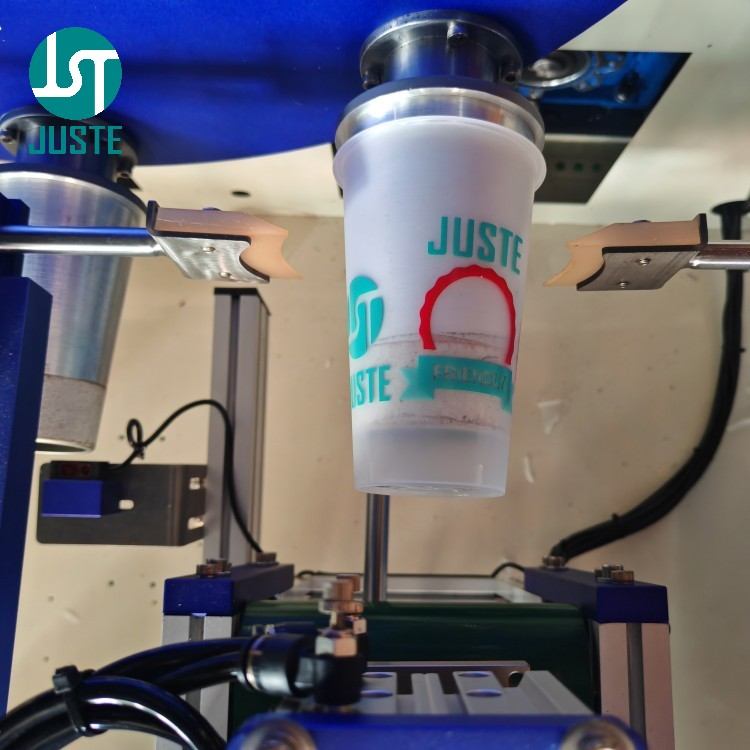
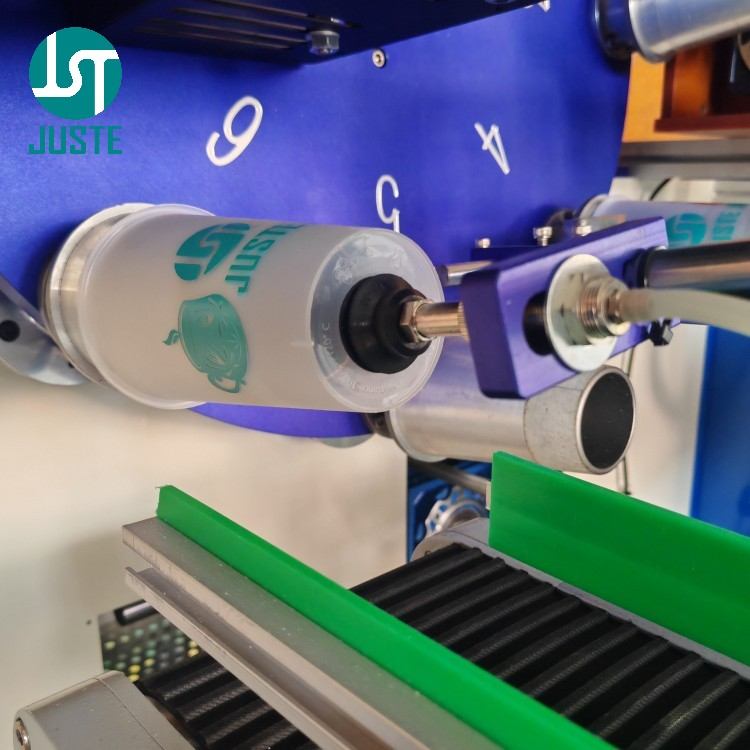
Automatische Zuführstation für Plastikbecher auf vollautomatischer Siebdruckmaschine
Betrieb: Ein mechanischer Greifer nimmt den Rohling auf und setzt ihn auf die Vorrichtung des 8‑Stationen‑Drehtisches.
Zweck / Prinzip: Diese Fütterungsmethode ist besonders geeignet für randlose Plastikbecher. Der Greifer hält den Becherkörper sicher, ohne den Rand zu beschädigen, und gewährleistet eine gleichbleibende Positionierung für den anschließenden Druckprozess.
Wichtige Hinweise: Für Plastikbecher mit Rand, bieten wir eine andere Lösung an, die höhere Geschwindigkeiten erreicht – bis zu 4.000 Becher pro Stunde. Allerdings für randlosen Plastikbechern — which are commonly used for Smoothie-Becher, Fruchttee-Becher, Und Reisetumblern — dieses greiferbasierte Zuführsystem bietet die beste Balance zwischen Geschwindigkeit und Präzision.
Station 2: Corona-Behandlung — Oberflächenvorbereitung
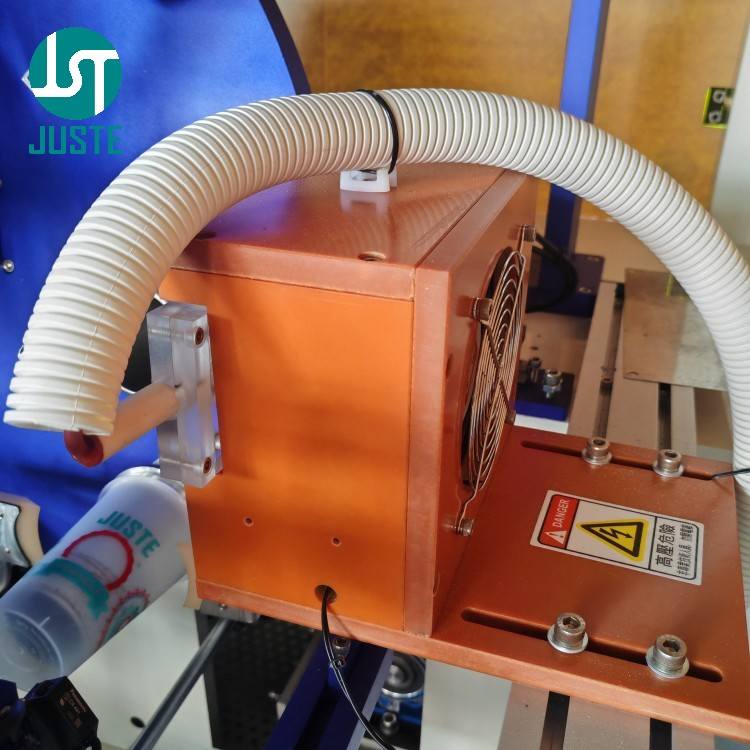
Corona-Behandlungsstation für PP-Becher auf vollautomatischer Siebdruckmaschine
Betrieb: Der Becher durchläuft die Corona-Behandlungsstation, wo hochfrequente elektrische Entladung die Oberflächenenergie des Kunststoffs modifiziert.
Zweck / Prinzip: Für Plastikbecher — besonders PP-Becher — die Oberflächenenergie ist von Natur aus niedrig, was zu einer schlechten Haftung der Druckfarbe führt. Durch eine Coronabehandlung wird die Oberflächenenergie erhöht, sodass die Druckfarbe fest auf der Becheroberfläche haften kann.
Wichtige Hinweise: Dieser Schritt ist essentiell für PP- und PE-Plastikbecher. Wenn Sie auf Pappbechern oder Pappschalen drucken, kann dieser Schritt vollständig übersprungen werden.
Station 3: Produkterkennung — Vermeidung von Leerdruck
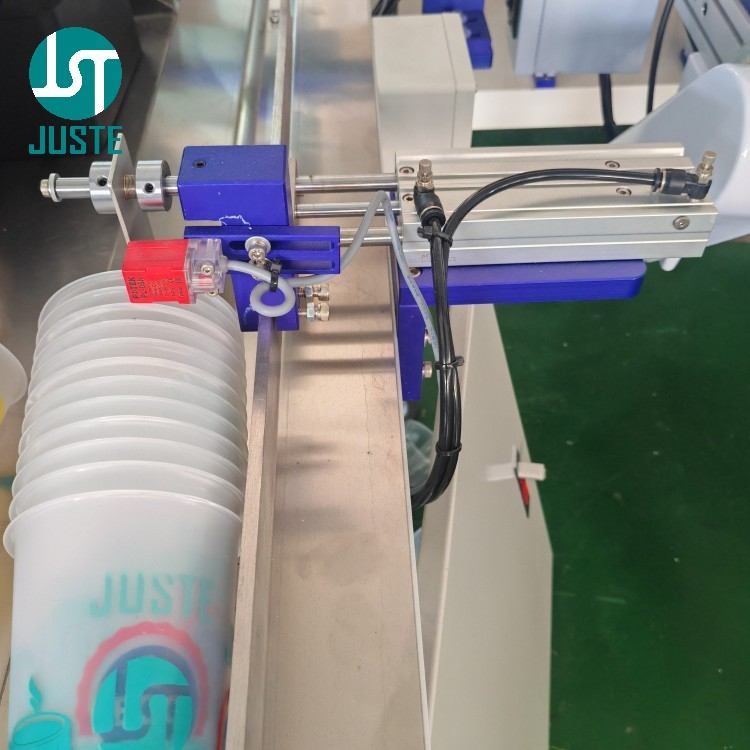
Betrieb: Ein Sensor überprüft, ob sich ein Becher auf der Halterung an Station 3 befindet.
Zweck / Prinzip: Wenn der Sensor keinen Becher auf der Halterung erkennt, die Maschine stoppt automatisch und löst einen Alarm aus. Dies verhindert, dass die Druckstation Tinte auf eine leere Halterung aufträgt — das vermeidet Tintenverschmutzung und mögliche Maschinenschäden.
Wichtige Hinweise: Diese Sicherheitsfunktion schützt sowohl die Maschine als auch den Bediener. Ohne diese Erkennung würde Tinte direkt auf die Metallvorrichtung gedruckt werden, was eine zeitaufwändige Reinigung erfordert und möglicherweise die zukünftige Druckqualität beeinträchtigt.
Station 4: Printing Station — The Core Action
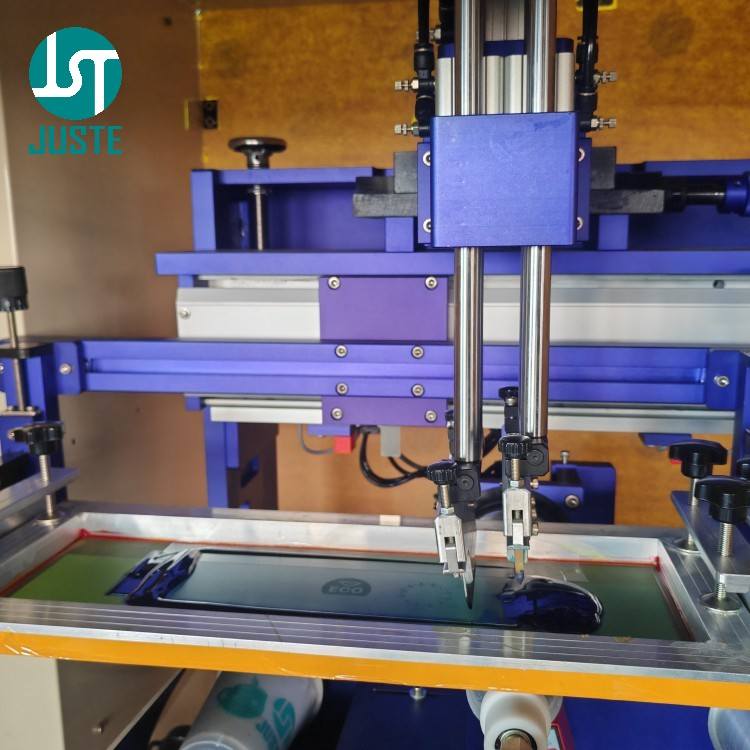
Printing station with servo-driven screen movement on plastic cup screen printing machine
Betrieb: The screen moves left‑to‑right via a servo‑driven lead screw, while the cup fixture rotates synchronously. The squeegee presses down, forcing ink through the mesh onto the cup surface.(The standard model requires manual adjustment of the printing stroke and is not driven by a servo motor.)
Zweck / Prinzip: The print stroke must be set correctly — greater than the logo width, but less than the cup circumference at the printing position. This ensures complete ink transfer without overlapping or missing areas.
Wichtige Hinweise: The printing stroke is adjustable via the touchscreen PLC. Operators can fine‑tune the start and end positions based on the specific logo size and cup diameter. This flexibility makes the machine suitable for a wide range of Plastikbecher designs — from small logos on 4 oz cups to full‑wrap patterns on 32 oz Tumbler-Bechern.
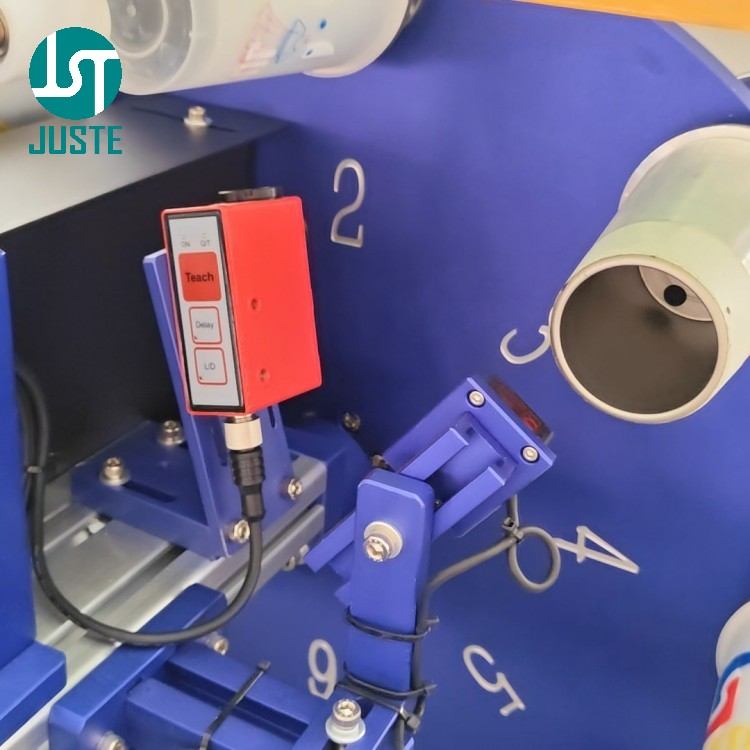
Leuze contrast sensor and servo motors for multi-color overprint upgrade on plastic cup screen printer
Betrieb: Der red device on the left is a Leuze contrast sensor, which detects registration marks on the cup or screen. The black device on the right is a seam line sensor, which detects the paper cup seam to avoid printing over it.
Zweck / Prinzip: This is an optional upgrade package that enables multi‑color overprint on a single‑color machine. To achieve this, three components must work together:
① Leuze contrast sensor — detects registration marks for precise color‑to‑color alignment
② Servo motor (screen movement) — controls the screen frame left‑to‑right with high precision
③ Servo motor (fixture rotation) — controls the cup fixture rotation, synchronized with the screen
These three components work in coordinated motion to achieve high‑precision registration between colors. The seam line sensor is specifically for paper cups with a visible seam — it detects the seam and adjusts the print position to avoid printing over it.
Wichtige Hinweise: Both sensors and the two additional servo motors are optional add‑ons, not part of the standard machine configuration. If you are printing single‑color jobs only, the standard JST-R300-ACSM without these upgrades is sufficient. For Starbucks‑style cups or other multi‑color designs, this upgrade is recommended.
Station 5: Inspection Station — Quality Check (Adjustment Use)
Betrieb: After printing, the cup passes through Station 5, which is used for visual inspection of the printed pattern.
Zweck / Prinzip: This station is primarily used during machine setup and adjustment. Operators can inspect the printed pattern for defects — such as misregistration, incomplete ink transfer, or blurred edges — without stopping the production line.
Wichtige Hinweise: During normal high‑speed production, visual inspection may be performed periodically rather than on every cup. The station provides a convenient position for quality sampling without disrupting the workflow.
Station 6: UV Curing — Instant Ink Drying
UV curing station for plastic cup screen printing on Fully Automatic Screen Printing Machine
Betrieb: Immediately after printing, the cup enters the UV curing box, where UV‑LED light instantly cures the ink.
Zweck / Prinzip: UV inks are formulated to cure instantly when exposed to UV light. This provides immediate drying — no smudging, no waiting, no need for additional drying racks or ovens.
Wichtige Hinweise: The UV curing time is adjustable via the touchscreen PLC. For different ink formulations and cup materials, the curing time may need to be fine‑tuned. UV LED curing is energy‑efficient Und safe for plastic cups, as it does not generate excessive heat that could deform the cup.
Station 7: Unloading — Automatic Cup Removal
Automatic unloading station with rubber suction pad for plastic cups on Fully Automatic Screen Printing Machine
Betrieb: A rubber suction pad picks up the finished cup from the fixture and transfers it to the outfeed conveyor.
Zweck / Prinzip: The rubber pad creates suction that lifts the cup off the fixture, then moves it to the conveyor for stacking. This method is gentle on printed surfaces — the rubber does not scratch or smudge the freshly cured logo.
Wichtige Hinweise: When designing the cup fixture, do not make it too tight. If the fixture grips the cup too firmly, the suction may not provide enough force to remove the cup, causing unloading failures. The fixture should hold the cup securely during printing but release it easily during unloading.
⚠️ Failure handling: If a cup fails to be removed at Station 7, it continues to Station 8, where a sensor detects the presence of the cup and triggers a machine stop and alarm. The operator must manually remove the cup from Station 8 before restarting production.
Station 8: Stacking & Counting — Finished Product Collection
Automatic stacking and counting station for finished plastic cups on Fully Automatic Screen Printing Machine
Betrieb: After curing and unloading, finished cups travel along the conveyor to the stacking area. The stacking mechanism collects cups and pushes them to the storage area once a preset count is reached.
Zweck / Prinzip: Der automatic stacking system eliminates manual counting and stacking labor. Cups are stacked to a user‑defined quantity, then automatically pushed to the storage area — ready for packaging.
Wichtige Hinweise: The stacking count is fully adjustable via the touchscreen PLC. Operators can set the desired number per stack based on packaging requirements. The entire process — from feeding to stacking — is fully automated, requiring no manual intervention.
Häufig gestellte Fragen (FAQ)
Q: Does this machine work for all types of plastic cups? A: The JST-R300-ACSM is specifically designed for tapered/conical plastic cups — both PP and PET — in sizes ranging from 4 oz to 32 oz. It is besonders geeignet für randlose Plastikbecher, which are common for Smoothie-Becher, Fruchttee-Becher, Und Reisetumblern. For pure cylindrical containers, we do not recommend this machine.
Q: Why does my printed logo peel off when I add ice cubes to the cup? A: This happens because standard screen printing inks become brittle and lose adhesion at low temperatures. For cold beverage applications — such as Kaltbechern im Starbucks-Stil or iced Smoothie-Becher — we recommend low‑temperature resistant PP screen printing ink, which maintains adhesion in freeze tests down to ‑5°C to ‑10°C.
Q: What is the difference between the standard machine and the optional upgrade? A: The standard JST-R300-ACSM is a single‑color machine. The optional upgrade adds a Leuze contrast sensor + 2 servo motors, enabling multi‑color overprint with high registration precision. The upgrade also includes a seam line sensor for paper cups. All of these are add‑on components, not part of the standard configuration.
F: Sind Sie ein Hersteller oder ein Handelsunternehmen? A: We are the manufacturer. Shenzhen Juste Machine Co., Ltd. has been designing and building screen printing equipment since 2013 in our own 9,000+ m² factory in Shenzhen. You can verify this during a free live video factory tour — our English‑speaking sales team will walk you through our CNC workshop, assembly lines, and QC stations in real time.
F: Kann ich die Maschine beim Drucken meines Produkts sehen, bevor ich bezahle? A: Absolutely. This is our standard practice. Send us a few blank samples and your artwork. We’ll custom‑machine a fixture (if needed), run the print test, and invite you to a live video demo — where you watch the machine print your product in real time, guided by our engineer. If you’re not convinced, you walk away with zero obligation.
Ihr Produkt, derselbe Prozess — Sehen Sie es live, in fließendem Englisch
You’ve just watched our engineer Alan explain the JST-R300-ACSM and its optional upgrade capabilities. Now imagine getting a private, real‑time video walkthrough of your own Plastikbecher being printed, guided by our 20‑year PLC engineer — alles in fließendem Englisch, ohne jegliche Kommunikationsbarrieren.
🔹 Schritt 1: Send us your design and a few blank cup samples.
🔹 Schritt 2: We’ll custom‑machine a fixture (in‑house CNC, ±0.01 mm) and run your print test.
🔹 Schritt 3: We go live on video — our English‑speaking engineer shows you everything, answers your technical questions on the spot, and you see the final print result in real time.
Es besteht null Risiko. If you’re not 100% convinced, you walk away with no obligation. And before shipping, we’ll do a pre‑shipment video inspection with you, so you know exactly what’s in the crate.
Not sure which screen printing machine fits your Plastikbecher? Or need a custom fixture for your specific taper angle?
👇 Klicken Sie auf mein Foto unten, um direkt mit mir auf WhatsApp zu chatten — ich sende Ihnen innerhalb von 8 Stunden ein kostenloses, maßgeschneidertes Angebot.